Simulating the Hunt
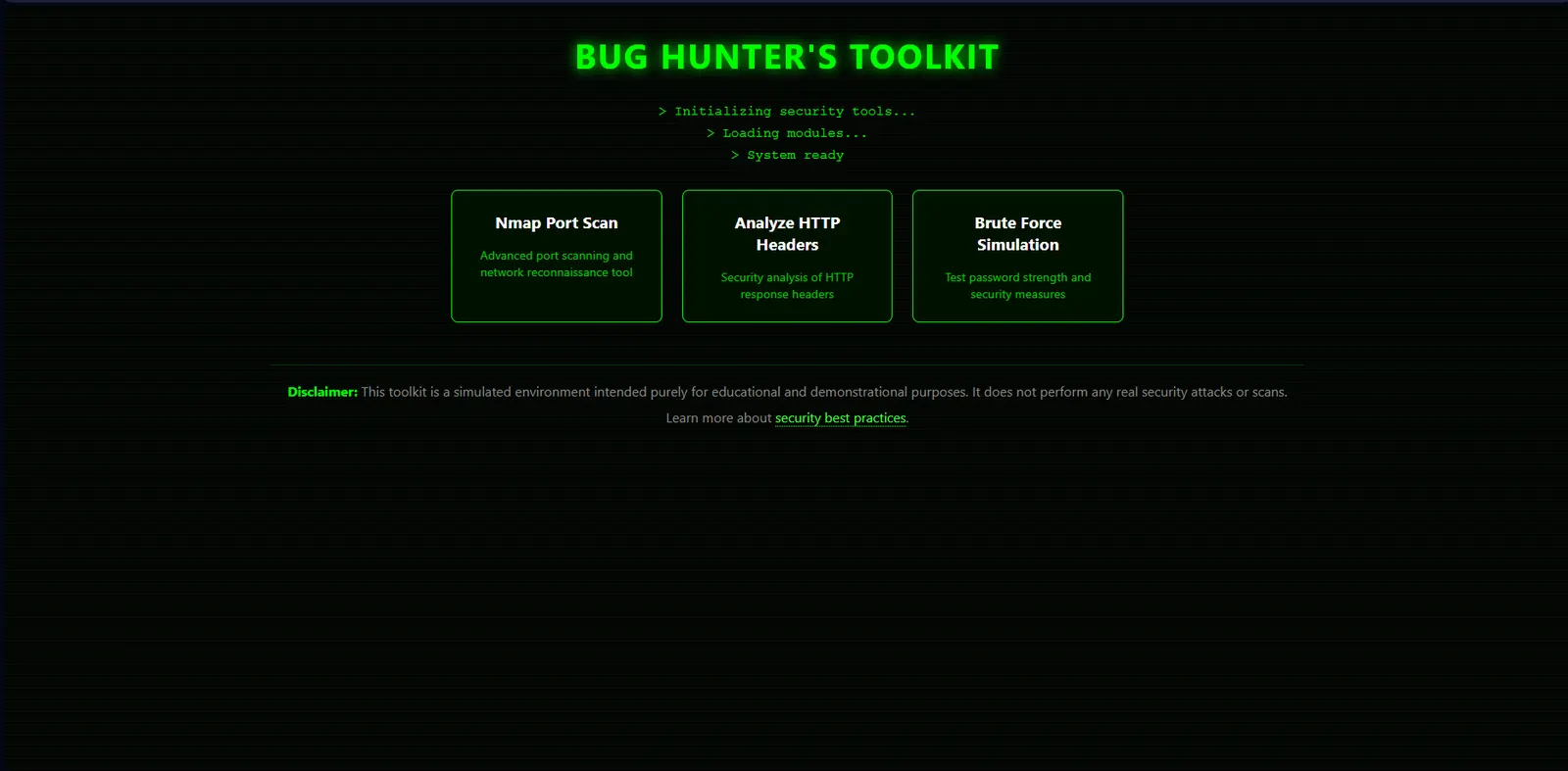
A controlled environment that replicates real-world security scenarios—built for showcasing penetration testing logic, responsible disclosure workflows, and ethical bug hunting practices.
Context
A controlled environment that replicates real-world security scenarios—built for showcasing penetration testing logic, responsible disclosure workflows, and ethical bug hunting practices.
Goals
- Simulated Nmap Port Scanning - Emulates Nmap CLI output to demonstrate the fundamentals of network reconnaissance in a safe, sandboxed environment.
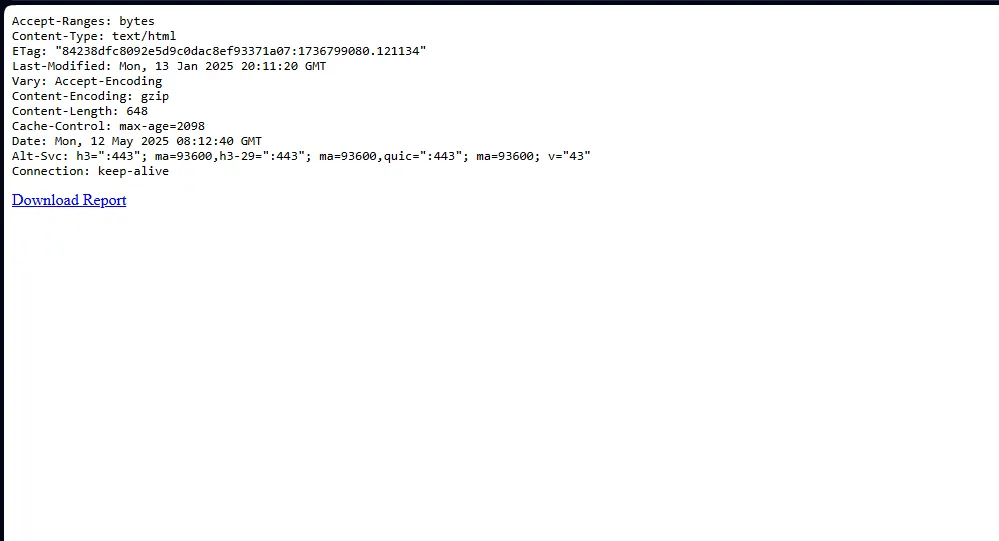
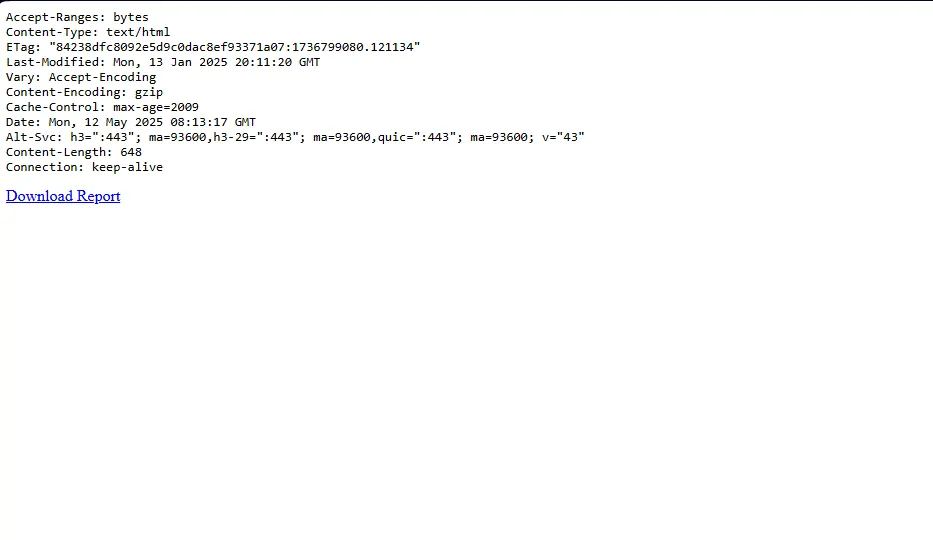
- HTTP Header Inspector - Fetches and displays response headers from real-world websites, offering insights into server behavior and configuration.
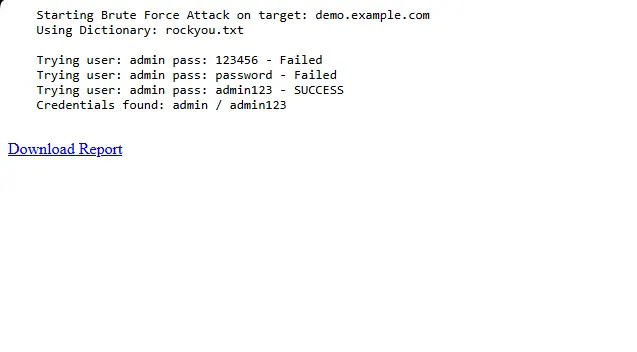
- Brute Force Simulation - Demonstrates a dictionary attack on a fictional target with mock credential responses—purely for educational purposes.
- Exportable Reports - All simulations can be exported as .txt files for documentation or educational reference.
- Ethical Disclaimer Included - Clear messaging throughout the app emphasizes its educational nature, with links to best security practices and ethical hacking guidelines.
Constraints
- Deployment platform (Nixpacks) failed to auto-detect Django, requiring manual provisioning using custom Procfile, requirements.txt, and runtime.txt.
- Django ORM constraints necessitated mock database configurations, despite the app being non-persistent.
- Extra caution was taken to ensure the project couldn't be misunderstood or misused as an actual attack tool.
Approach
- Custom build pipeline added for Railway deployment, including minimal Django requirements.
- Migrations were satisfied using mock schemas to fulfill Django's expectations without storing real data.
- Ethical considerations implemented via static disclaimers and best-practice references—reinforcing that the toolkit is a controlled simulation, not an exploit platform.
Results
- Automated scanning workflows packaged behind a clean UI.
Stack
Frontend
HTML/CSS
Backend
PythonDjango
Security
python-nmapRequests
Ops
RailwayGunicorn
Project Gallery
Related projects
Grammar, Engineered
A non-formal learning tool built to support students and language enthusiasts in acquiring Greek grammar naturally. The platform includes utilities like a noun decliner, verb conjugator, smart vocabulary recording, and a unique etymological analyzer for Greek-rooted words in foreign languages. Currently under active development. Expected to evolve into a fully usable app supporting students and educators in Greek and possibly other language studies.
EduSaaS
Decoding OAuth Flow
A comprehensive frontend simulation of modern authentication workflows using the OAuth 2.0 protocol. This project demonstrates how secure access is granted through token exchange, redirection, and user authorization — without relying on third-party providers. It introduces role-based access control (RBAC) and showcases how permission logic is structured and enforced within an application. Designed for clarity and adaptability, this showcase serves as a blueprint for building secure and scalable login systems that prioritize user data protection and system integrity.
Security tool
Streaming, End to End
MiniVod is a commercial video-on-demand product built for ViewMini — premium short-form series and films for English, Greek, and Arabic audiences. What began as an AI-assisted frontend scaffold grew into a production system: a React SPA hosted on Lovable, a Django REST API on Heroku, and a native iOS app with TestFlight beta distribution.
OTTSaaS